CPOW Pipeline Documentation
This directory contains detailed technical documentation for the CPOW (Continuous Point-on-Wave) data pipeline, covering high-performance data acquisition, shared memory operations, and real-time processing.
Pipeline Overview
The CPOW data pipeline consists of two main processes that work together to capture, process, and store high-frequency power measurement data at 32kHz across 7 channels.
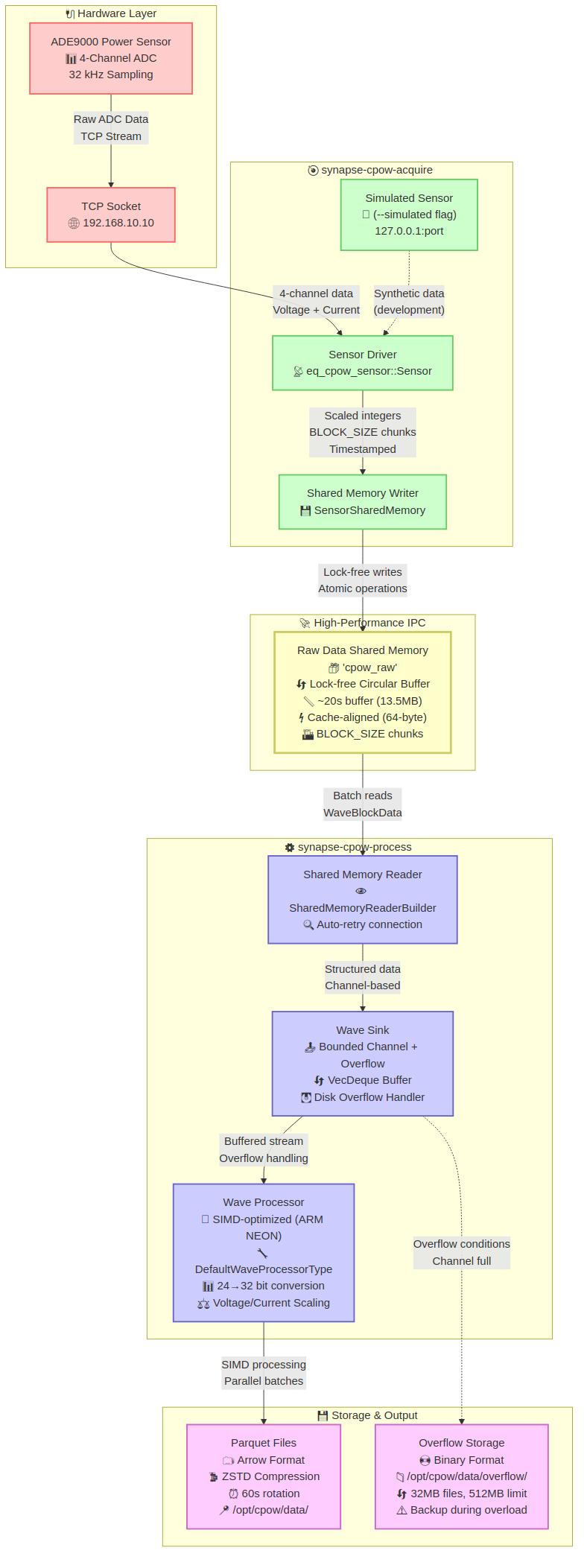
Data Flow
- Hardware Layer: ADE9000 sensor captures 4-channel power data at 32kHz
- Acquire Process: Reads sensor data via TCP and writes to shared memory
- Shared Memory IPC: High-performance lock-free circular buffer for inter-process communication
- Process Process: Reads from shared memory, processes with SIMD optimizations, outputs to Parquet files
- Storage: Compressed Parquet files with overflow handling
Key Features
Performance:
- Lock-free shared memory with atomic operations
- SIMD-optimized processing (ARM NEON)
- High-priority threads for real-time performance
- Cache-aligned data structures
- Zero-copy design where possible
Robustness:
- Graceful shutdown handling
- Connection retry logic
- Buffer overflow detection and recovery
- Data integrity verification
synapse-cpow-process Architecture
The synapse-cpow-process component reads raw sensor data from shared memory, transforms it through SIMD-optimized processing, and outputs structured Parquet files.

Core Data Flow
SensorDataRow (21 bytes)
    ↓ [SharedMemoryReader]
WaveBlockData batches
    ↓ [WaveSink buffering]
Bounded channel stream
    ↓ [24→32 bit conversion]
DataBuffer (i32 circular buffer)
    ↓ [SIMD scaling operations]
Scaled float32 data
    ↓ [Arrow serialization]
Parquet files (ZSTD compressed)
Channel Mapping
Channel 0: IA (Current A)   - iscale factor
Channel 1: VA (Voltage A)   - vscale factor
Channel 2: IB (Current B)   - iscale factor
Channel 3: VB (Voltage B)   - vscale factor
Channel 4: IC (Current C)   - iscale factor
Channel 5: VC (Voltage C)   - vscale factor
Channel 6: IN (Neutral)     - iscale factor
Detailed Documentation
CPOW Data Processing Pipeline
cpow_process_analysis.md
Level: Advanced/Expert
Complete architectural deep dive into the CPOW process binary (synapse-cpow-process):
- Data pipeline from sensor acquisition through Parquet file output
- Shared memory reader/writer implementation
- Arrow IPC integration for columnar data storage
- NEON optimization for ARM platforms
- Command-line interface and configuration options
- Error handling and recovery mechanisms
Key sections:
- Section 2: Data Pipeline Architecture
- Section 7: Processing Pipeline Detailed Walkthrough
- Section 10: Performance Considerations
Shared Memory Operations (eq-memops)
eq_memops_analysis.md
Level: Advanced/Expert | Recommended starting point
The eq-memops crate provides foundational shared memory abstractions:
- Generic
SharedMemoryAccesstrait and implementations ArrowSharedMemorylock-free multi-reader architectureSharedMemoryReaderpatterns and builder API- Multi-reader support (up to 16 concurrent readers)
- Memory layout, alignment, and atomic synchronization
- NEON optimization for ARM platforms
Key sections:
- Section 2: Arrow Shared Memory Implementation
- Section 3: Reader/Writer Patterns
- Section 7: Memory Layout & Synchronization
eq_memops_visuals.md
Level: Intermediate to Advanced | Companion to eq_memops_analysis.md
Visual ASCII diagrams covering:
- Data flow architecture
- Memory layout diagrams
- Writer-reader synchronization flowcharts
- State machines and error transitions
SUMMARY.txt
Plain text alternative to eq_memops_analysis.md with linear narrative flow.
Configuration & Deployment
MEMORY_CONFIG_REFERENCE.md
Level: Intermediate | Audience: DevOps, deployment engineers
Memory-related configuration parameters:
- DuckDB pool and query configuration
- Shared memory buffer sizing
- Connection limits and WebSocket configuration
- Memory budget analysis (current vs edge-optimized)
- Edge device configuration overrides
WebSocket Integration
WEBSOCKET_BATCH_AGGREGATION.md
WebSocket batch aggregation for real-time data streaming.
Reading Paths
New to the Codebase
- eq_memops_visuals.md - Visual overview
- eq_memops_analysis.md sections 1-4 - Foundational concepts
- cpow_process_analysis.md section 2 - Data flow understanding
- MEMORY_CONFIG_REFERENCE.md - Deployment considerations
Performance Optimization
- cpow_process_analysis.md section 10 - Performance Considerations
- eq_memops_analysis.md section 13 - Performance Characteristics
- MEMORY_CONFIG_REFERENCE.md - Configuration tuning
Debugging Issues
- cpow_process_analysis.md section 9 - Error Handling & Recovery
- eq_memops_analysis.md section 8 - Error Handling Hierarchy
- eq_memops_visuals.md section 8 - Error State Transitions
Quick Reference
Key Concepts
- WaveBlockData: 256-row blocks of 7-channel sensor data (8ms @ 32kHz)
- SensorSharedMemory: Raw 24-bit sensor data circular buffer
- ArrowSharedMemory: Lock-free multi-reader Arrow IPC shared memory
- DataBuffer: Conversion layer from 24-bit to 32-bit with batch views
- NEON optimization: ARM SIMD acceleration for data conversion
Critical Constants
N_ROWS_PER_BLOCK: 256 rowsSAMPLE_HZ: 32,000 HzN_CHANNELS: 7 (ia, va, ib, vb, ic, vc, i_n)ROWS_PER_BATCH: 320,000 rows (10 seconds)MAX_READERS: 16 concurrent readers
Key Source Files
eq-memops/src/ipc/arrow.rs: Arrow shared memory implementationeq-memops/src/ipc/reader.rs: Generic shared memory readersynapse-cpow/process/src/bin/default.rs: CPOW process binary entry pointeq-cpow/sensor/src/lib.rs: Sensor shared memory interface
Related Documentation
- PMON Pipeline - Power monitoring pipeline
- Unified Backend API - Backend API and server architecture
- Library Crates - Overview of Rust crates and dependencies
- Traits and Generics - Rust patterns used in the codebase
- Individual crate READMEs in
server/crates/directory
Last Reviewed: 2026-02-02
© 2026 EQ Systems Inc.